The Nematology Sub-Laboratory, Department of Plant Pests and Diseases, Faculty of Agriculture, Universitas Gadjah Mada (UGM), is organizing an Advanced Course: Molecular Aspect of Plant-Nematode Interaction, providing an opportunity for academics, researchers, students, and professionals to deepen their understanding of molecular plant–nematode interactions. Scheduled to be held in a hybrid format on 6–7 August 2026, the course will explore the molecular mechanisms underlying plant defense, nematode parasitism, and the latest technologies applied in molecular nematology research.
The program reflects the commitment of the UGM Nematology Sub-Laboratory to strengthening human resource capacity in plant health research, particularly in the rapidly evolving field of molecular plant-parasitic nematodes. By combining scientific lectures, interactive discussions, and experimental consultation sessions, the course aims to provide participants with a comprehensive understanding of plant–nematode interactions and their application in research and sustainable disease management strategies.
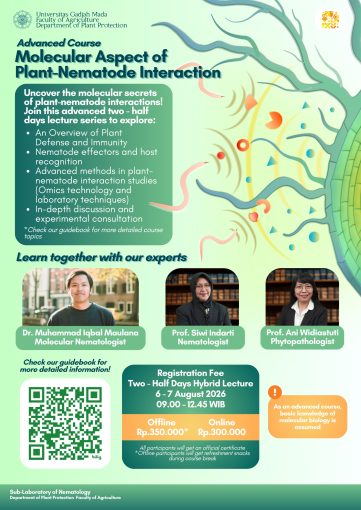
The course will feature three distinguished experts: Dr. Muhammad Iqbal Maulana, a Molecular Nematologist; Prof. Siwi Indarti, a Nematologist; and Prof. Ani Widiastuti, a Phytopathologist. Through their respective areas of expertise, the speakers will share current advances in molecular nematology, plant defense mechanisms, and multidisciplinary approaches to understanding host–nematode interactions.
Over two and a half days, participants will attend sessions covering Plant Defense and Immunity, Nematode Effectors and Host Recognition, and Advanced Methods in Plant–Nematode Interaction Studies, including omics technologies and modern molecular laboratory techniques. The program also includes in-depth discussions and experimental consultation, enabling participants to exchange ideas on research design, laboratory methodologies, and emerging challenges in molecular nematology research.
As an advanced-level program, the course is intended for participants who already possess a fundamental understanding of molecular biology. Conducted through a hybrid lecture format, the program offers flexibility for participants to attend either on-site at the Faculty of Agriculture, UGM, or online from different regions. All participants will receive an official certificate upon successful completion of the course.
Through this initiative, the UGM Nematology Sub-Laboratory seeks to create a platform for scientific exchange, strengthen research collaboration, and stimulate innovation in molecular nematology and plant protection. By offering topics aligned with the latest scientific developments, the course is expected to enhance the capacity of researchers and academics to address increasingly complex challenges posed by plant-parasitic nematodes in sustainable agriculture.
The Advanced Course: Molecular Aspect of Plant-Nematode Interaction contributes to several United Nations Sustainable Development Goals (SDGs). It supports SDG 2 (Zero Hunger) by strengthening scientific capacity to develop sustainable nematode management strategies that enhance agricultural productivity. The program also advances SDG 4 (Quality Education) through high-quality, research-based learning, SDG 9 (Industry, Innovation and Infrastructure) by promoting the application of molecular and omics technologies in plant protection research, and SDG 17 (Partnerships for the Goals) by fostering collaboration among universities, researchers, and stakeholders to advance plant health science at both national and international levels.