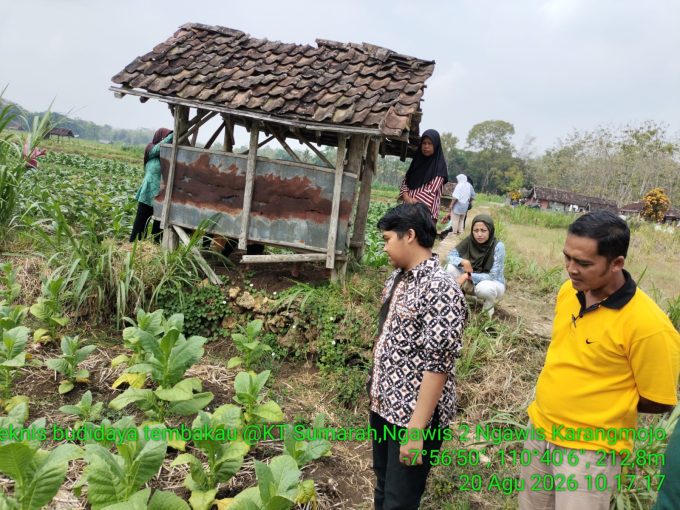


GUNUNGKIDUL – The Agriculture and Food Office of Gunungkidul Regency organized a Technical Training on Tobacco Cultivation funded by the Tobacco Revenue Sharing Fund (DBHCHT) for Fiscal Year 2026. The training took place at the Secretariat of the Sumarah Farmers Group (KT Sumarah), Ngawis 2 Hamlet, Ngawis Village, Karangmojo District, Gunungkidul Regency, on Thursday (20/8/2026).
This program aims to enhance the capacity, knowledge, and practical skills of local farmers in adopting cultivation technologies based on Good Agricultural Practices (GAP) to optimize production yields and the quality of local tobacco in the Karangmojo area.
In this event, Dr. Ady Bayu Prakoso, S.P., an academic and expert from the Department of Plant Protection, Faculty of Agriculture, Universitas Gadjah Mada (UGM), served as the keynote speaker. The training focused on comprehensive identification and integrated management strategies for Plant Pests and Diseases (OPT) across every stage of tobacco cultivation.
Integrated Pest and Disease Management Across Growth Stages
- Pre-Planting Phase: Emphasis on optimal land sanitation, proper soil preparation, selection of certified pathogen-free seeds/seedlings, and preventive measures against soil-borne pathogens and nursery pests.
- Planting Phase (Vegetative to Generative Stages): Early identification and precise integrated management of major insect pests (such as armyworms and aphid virus vectors) and key diseases (such as black shank/lanas, bacterial/fungal wilt, and mosaic viruses).
- Post-Harvest Phase: Protecting harvested tobacco leaves during picking, curing, chopping, sun-drying, and storage to prevent rot molds and storage pests from deteriorating leaf quality.
| Introduction to Biological Control Agents: Alongside conventional technical practices, Dr. Ady Bayu Prakoso introduced the fundamentals of utilizing biological control agents (such as antagonistic microorganisms and natural predators) as eco-friendly alternatives to maintain agroecological balance and sustainably suppress pest populations. |
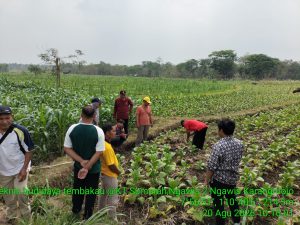
The session was held interactively, combining classroom theoretical explanations with an on-site field trip directly in the tobacco fields of KT Sumarah. A total of 25 participating farmers actively engaged in identifying symptom manifestations and discussing on-field remediation steps.
Tangible Contributions to Sustainable Development Goals (SDGs)
- SDG 1 (No Poverty): Mitigating crop failure risks and safeguarding the quality and market value of tobacco yields to enhance farmers’ household income and financial resilience.
- SDG 8 (Decent Work and Economic Growth): Improving labor efficiency, land productivity, and the competitiveness of smallholder plantation commodities in rural communities.
- SDG 12 (Responsible Consumption and Production): Encouraging eco-friendly practices through GAP standards, introducing biological control agents, and reducing synthetic chemical pesticide reliance to preserve agroecosystems.
- SDG 15 (Life on Land): Supporting soil health conservation and biodiversity in agricultural landscapes through sustainable integrated plant protection approaches.
- SDG 17 (Partnerships for the Goals): Fostering strategic synergies between academic institutions (Faculty of Agriculture, UGM), local government (Gunungkidul Agriculture and Food Office), and local farming communities (KT Sumarah).